Abstract
According to the National Institute of Mental Health, persistent overthinking about uncontrollable situations is associated with increased psychological stress, disrupted sleep, reduced cognitive performance, and a higher risk of anxiety and depressive symptoms. This article synthesizes established psychological and behavioral principles used in clinical and preventive mental health settings to explain why overthinking occurs when control is limited and how evidence-informed, non-pharmacological strategies can reduce cognitive overload. The focus remains on practical, scalable interventions appropriate for everyday use, rather than diagnostic or therapeutic replacement.
Introduction
Humans are biologically wired to anticipate threats and predict outcomes. This capacity supports survival; however, when repeatedly applied to situations outside personal control, it can become maladaptive. Persistent overthinking—often described clinically as rumination or excessive worry—places sustained demand on cognitive and emotional regulation systems.
From a clinical perspective, this pattern is not defined solely by the presence of stressors, but by how mental attention is allocated to those stressors. Attempts to control outcomes that are objectively uncontrollable create a mismatch between cognitive effort and actual influence, a well-established contributor to mental fatigue and emotional exhaustion.
Clarifying the Boundary Between Control and No Control
Mechanism
Psychological research shows that the brain experiences less stress when situations are clearly categorized. Ambiguity increases cognitive load and prolongs mental engagement.
Clinical relevance
Studies in stress psychology demonstrate that perceived lack of control amplifies physiological stress responses, even when objective threat levels remain low.
Practical application
Individuals can reduce unnecessary overthinking by classifying stressors into three categories:
- Directly controllable
- Indirectly influenceable
- Not controllable
This form of cognitive labeling reduces repetitive mental processing and conserves mental energy.
Why the Brain Gets Stuck in Repetitive Thinking
Mechanism
Overthinking persists when the brain lacks a clear “completion signal.”
Clinical relevance
Research on rumination indicates that unresolved cognitive loops maintain sympathetic nervous system activation, contributing to chronic stress.
Practical application
Clinically supported cognitive closure techniques include:
- Writing the concern once
- Identifying the next actionable step (or acknowledging none exists)
- Deliberately disengaging from further analysis
Harvard Health explains why the brain can become stuck in repetitive thinking when uncertainty remains unresolved. These strategies are commonly used in cognitive-behavioral interventions.
Stress, Control, and the Body’s Response
Mechanism
Mental overactivity often reflects physiological dysregulation rather than impaired reasoning.
Clinical relevance
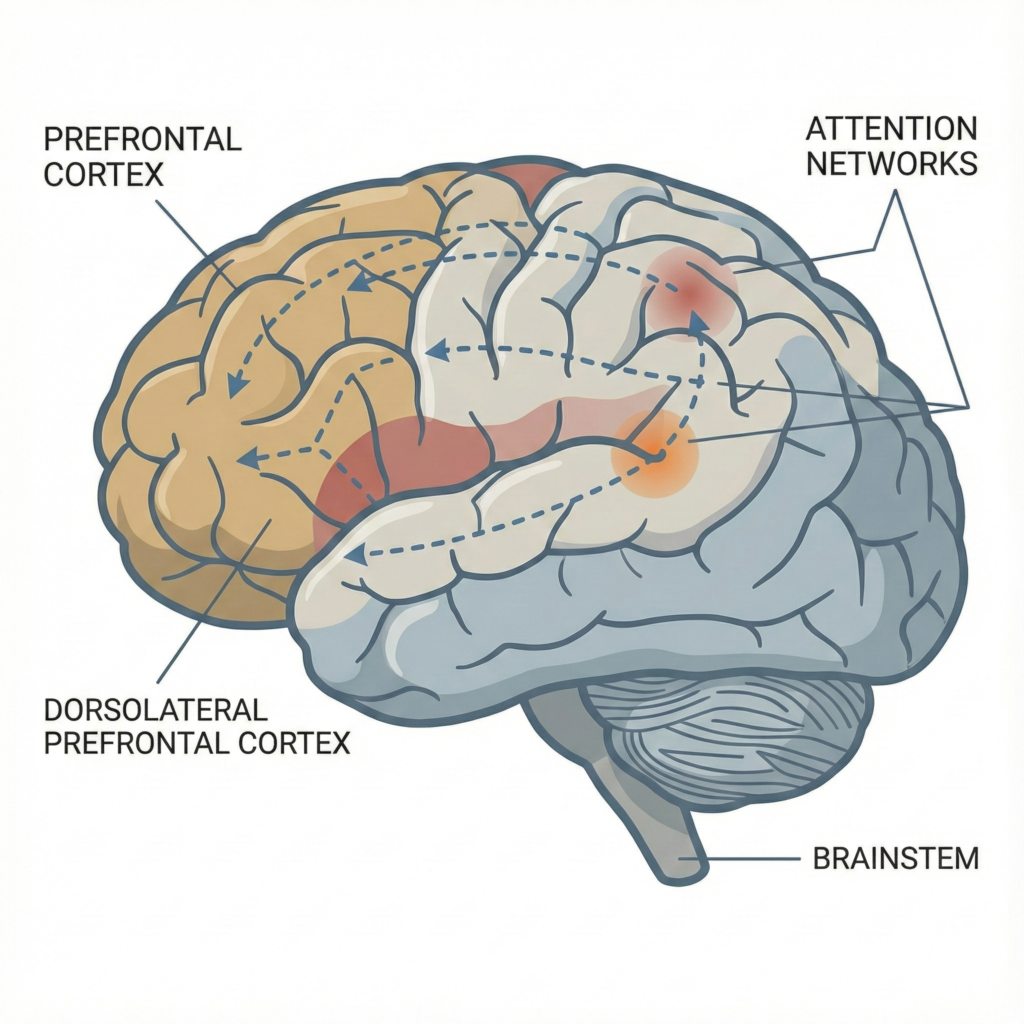
Sleep deprivation, dehydration, and prolonged stress reduce prefrontal cortex efficiency, limiting the brain’s ability to filter intrusive thoughts.
Practical application
Before attempting cognitive reframing, foundational regulation should be addressed:
- Consistent sleep patterns
- Regular meals and hydration
- Light physical movement
The American Psychological Association notes that prolonged stress affects attention, emotional regulation, and mental energy. This aligns with stepped-care models in mental health treatment.
Acceptance-Based Approaches & Letting Go of Control
Mayo Clinic highlights acceptance and awareness as effective ways to reduce stress linked to uncontrollable situations.
Mechanism
The brain interprets unlimited thinking time as necessary vigilance.
Clinical relevance
Time-restricted worry has been shown to reduce overall anxiety compared to unrestricted rumination.
Practical application
Implement scheduled worry periods (for example, 10–15 minutes daily). Outside this window, attention is intentionally redirected. This technique is widely used in anxiety management protocols.
Mindfulness & Cognitive Regulation
Mechanism
Outcome-focused thinking increases pressure, while process-focused thinking restores psychological agency.
Clinical relevance
Behavioral activation research supports focusing on values-based actions rather than outcome certainty to reduce mental strain.
Practical application
Reframe internal questions:
- From: “How do I prevent this outcome?”
- To: “What constructive action is appropriate today?”
This approach preserves motivation without increasing cognitive load.
Allowing Thoughts Without Engagement
Mechanism
Thought suppression increases rebound frequency.
Clinical relevance
Acceptance-based therapies demonstrate that observing thoughts without reacting reduces emotional distress.
Practical application
Use distancing language such as:
“I’m noticing a thought about…”
This reduces identification with thought content and lowers intensity.
Viewing Overthinking as a Signal, not a Failure
Persistent overthinking is also a key contributor to corporate mental exhaustion, especially in high-pressure work environments where the mind rarely switches off.
Mechanism
Self-judgment compounds cognitive strain.
Clinical relevance
Compassion-focused interventions are associated with reduced rumination and improved emotional regulation.
Practical application
Overthinking can be reframed as a signal of overload, prompting rest, boundary-setting, or physiological regulation rather than self-criticism.
Conclusion
Chronic overthinking about uncontrollable factors is not a personal weakness, but a predictable cognitive response to sustained uncertainty. Evidence-informed strategies that clarify control boundaries, regulate physiological stress, and limit cognitive overexposure can meaningfully reduce mental fatigue.
Effective intervention does not require eliminating thought, but rather redirecting attention toward what is actionable, restorative, and proportionate. In doing so, mental energy is preserved rather than depleted.
This article is intended for educational purposes and reflects principles commonly used in preventive and clinical mental health care. It does not replace individualized professional guidance.
Frequently Asked Questions
What is overthinking from a mental health perspective?
Overthinking refers to repetitive, unproductive thought patterns that do not lead to resolution or action. In mental health contexts, it is often associated with rumination or excessive worry, particularly about situations that cannot be controlled.
Why does overthinking things outside your control cause mental fatigue?
When the brain repeatedly focuses on uncontrollable situations, it remains in a heightened state of alert without achieving closure. This sustained cognitive effort increases stress and gradually depletes mental energy.
Is overthinking the same as anxiety or burnout?
Overthinking is not the same as anxiety or burnout, but it can contribute to both. Persistent overthinking may increase emotional strain and cognitive exhaustion, which can raise the risk of anxiety symptoms or burnout over time.
Can overthinking affect sleep and concentration?
Yes. Overthinking can interfere with sleep by keeping the mind in an alert state, making it harder to fall asleep or stay asleep. It can also reduce concentration, decision-making ability, and mental clarity during the day.
What are evidence-informed ways to reduce overthinking?
Evidence-informed approaches include clarifying what is and is not within your control, limiting time spent on repetitive worry, creating closure for unresolved thoughts, supporting sleep and physical regulation, and observing thoughts without engaging with them.
When should someone seek professional help for overthinking?
Professional support may be helpful if overthinking consistently disrupts sleep, work, relationships, or daily functioning, or if it is accompanied by persistent anxiety, low mood, or emotional exhaustion.